Search Dental Tribune

From chairside to cyberspace: AI can grow your practice and your risk too—Part 6

Cybersecurity expert Anne Genge argues that dental practices must adopt artificial intelligence with strong governance, limited access, human oversight and independent verification to protect patient privacy, accuracy and safety. (Wasan/Adobe Stock)

Mon. 26 October 2026

save

Artificial intelligence (AI) and augmented intelligence are rapidly becoming part of dentistry, and applications span imaging, documentation, treatment planning, patient communication and administration. While these technologies offer enormous potential to improve dental care and practice efficiency, they require thoughtful leadership and cannot replace the dentist’s expertise in diagnosis, treatment and follow-up care. As software gains access to patient information and increasingly generates content or takes actions, dental professionals must also consider the responsibilities surrounding privacy, oversight, accuracy and verification.

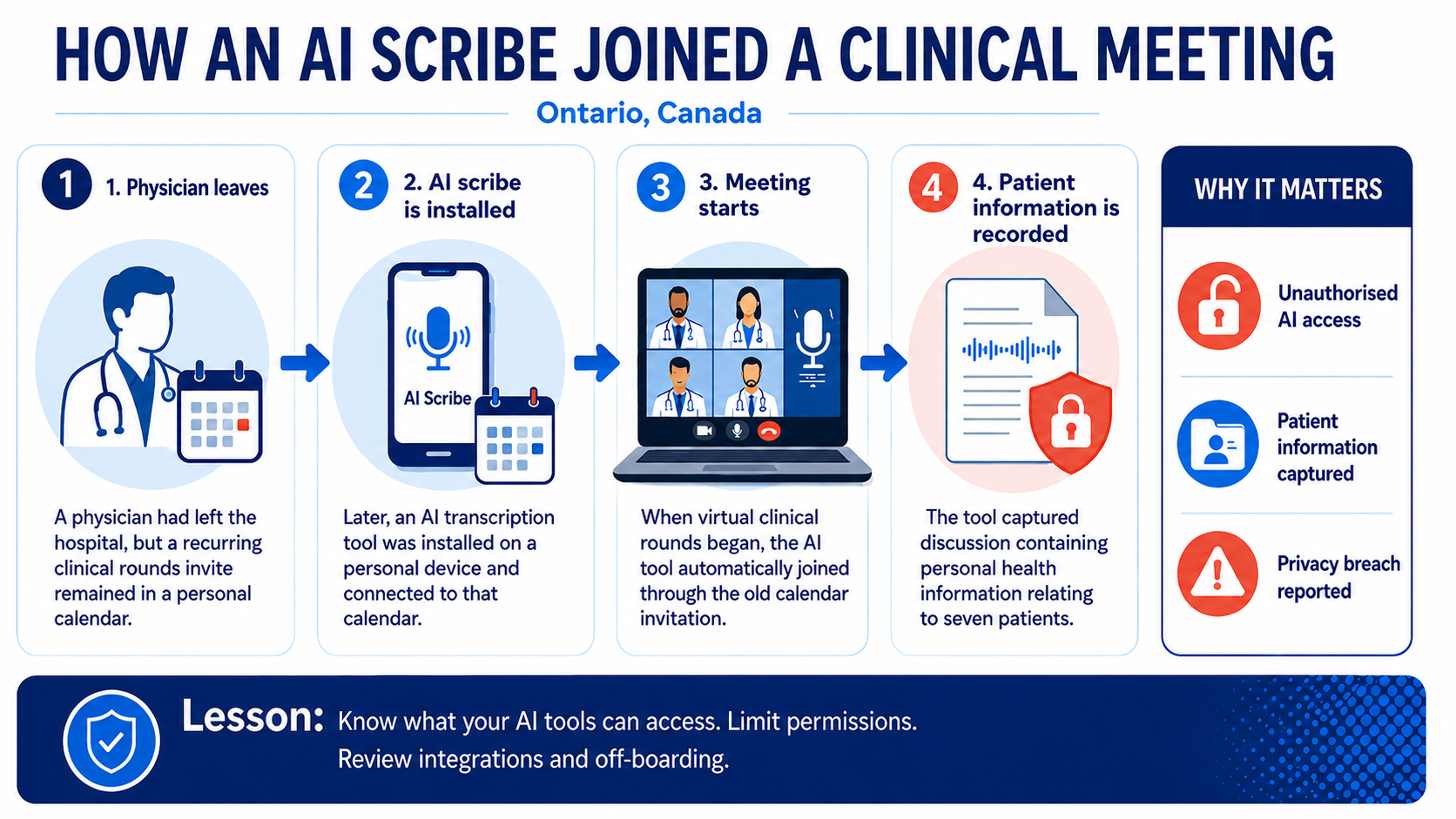
Sequence of events that allowed an unapproved AI transcription tool to access virtual clinical rounds at an Ontario hospital. (Image: Anne Genge)

Sequence of events that allowed an unapproved AI transcription tool to access virtual clinical rounds at an Ontario hospital. (Image: Anne Genge)

In Part 5 of this series, we looked at what happens when everything in a dental practice—scanners, cloud platforms, vendors, laboratories, AI-enabled tools—becomes interconnected and how AI can amplify existing cyber risks. In this next part, we look at what that means in the real world.

Cases from Canada, Australia and Hong Kong discussed in this article show that AI-related harm does not always resemble a traditional cyber-attack. An AI tool may reach information no one intended it to see. A person may enter sensitive data into a public AI service and receive an inaccurate answer. An AI agent may act without enough context, or AI may create something convincing enough that a human acts on a lie. These incidents preview the governance questions that will accompany everyday AI use in dentistry.

Access: When an AI tool reaches information it should not have

In September 2024, physicians at a hospital in Ontario in Canada were participating in virtual clinical rounds when an unexpected participant joined: an AI transcription tool. Otter.ai had not been approved by the hospital. According to the Information and Privacy Commissioner of Ontario, the account belonged to a physician who had left more than a year earlier, but a recurring invitation to the clinical rounds remained in the physician’s personal calendar. After the physician later installed the transcription tool on a personal device, it gained access to that calendar and automatically joined the meeting.

The tool captured personal health information relating to seven patients, including names and clinical information such as diagnoses, medical notes and treatment details. The hospital reported the incident to Ontario’s privacy regulator. There was no ransomware gang and no sophisticated intrusion. An AI application simply had access that no one had adequately accounted for.

The dental equivalent is easy to imagine. AI scribes, meeting assistants, browser extensions and productivity tools may request access to microphones, calendars, documents, email or cloud services. A practice therefore needs to ask not only whether a tool works, but what it can see, hear, retrieve, store and connect to. Access should be limited to what is necessary, and off-boarding should include calendars, meeting invitations, integrations and connected applications, not only log-in credentials. That is the goal, but the controls are still catching up. Many practices do not yet have reliable visibility into shadow AI, personal accounts or browser extensions, making it difficult to revoke access no one knew existed.

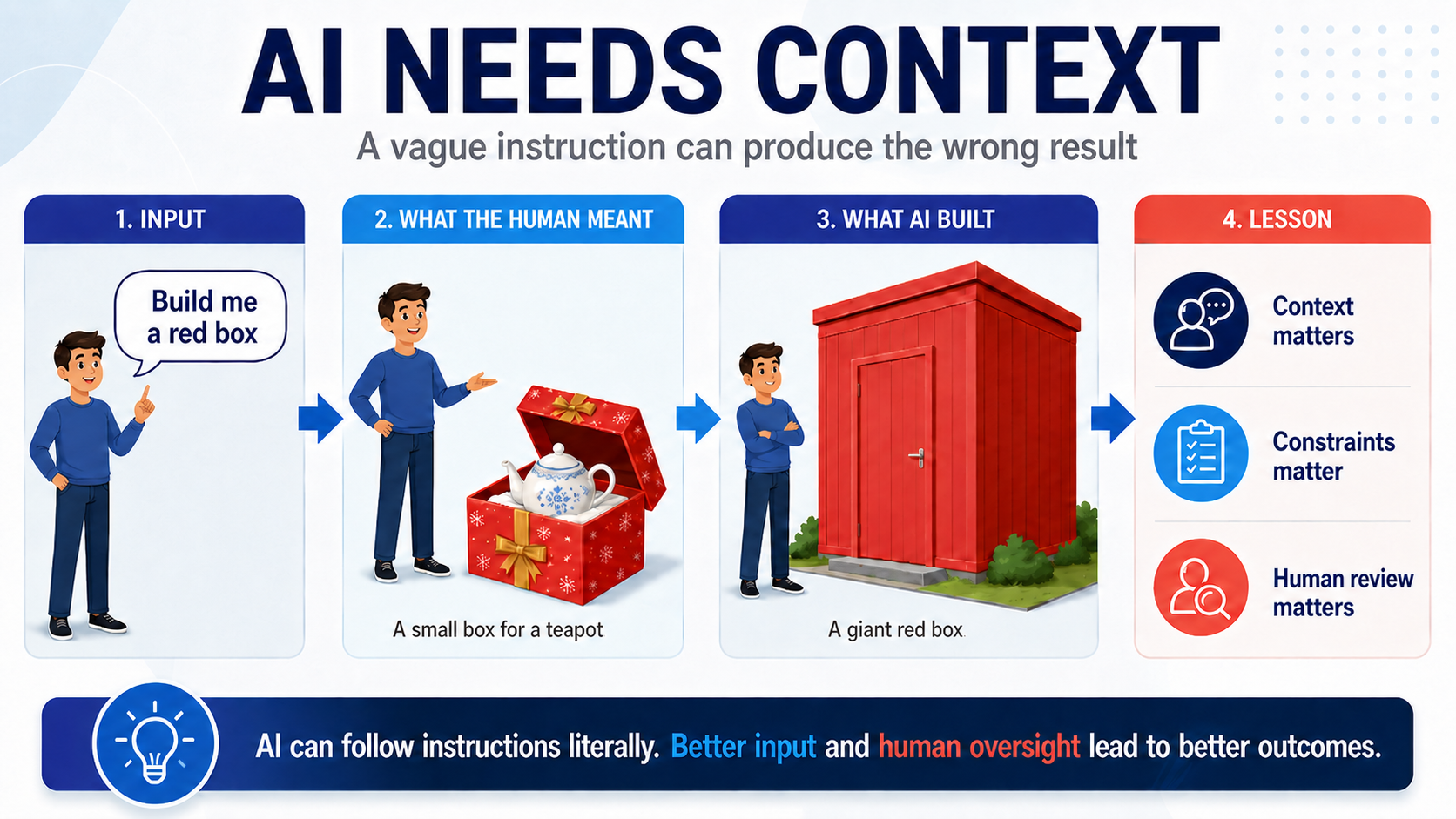
A simple illustration of why context, constraints and human review matter when AI is asked to act. Red box generated by ChatGPT. (Image: Anne Genge)

A simple illustration of why context, constraints and human review matter when AI is asked to act. Red box generated by ChatGPT. (Image: Anne Genge)

Input and output: When we give AI information we should not

A second incident, in Victoria in Australia, also in September 2024, shows the opposite risk: people giving AI information it should not have. A child protection worker used ChatGPT while preparing a report for the Children’s Court of Victoria. The Office of the Victorian Information Commissioner found that the worker entered personal and sensitive information into ChatGPT, including names and risk assessment information relating to a child.

The privacy problem was followed by an accuracy problem. AI-generated material used in the report contained inaccurate information that, according to the regulator, downplayed risks to the child. Generative AI can produce content that sounds polished and authoritative while still being wrong. In healthcare, that can make an error easier to overlook, not less consequential.

For dental practices, the temptation is obvious. A team member may paste part of a chart into a public AI tool for a summary, use AI to rewrite a referral or insurance appeal, or ask it to help answer a patient complaint. The intention may simply be to save time. But convenience does not answer the privacy questions: Where does the information go? Is it retained? Who can access it? Nor does it remove the need to verify the output. An elegant mistake is still a mistake, and AI-generated clinical or administrative content requires meaningful human review.

Context and authority: When AI can act before it fully understands

As AI moves from answering questions to taking actions, context becomes even more important. Consider a simple example. A person tells an AI system, “Build me a red box.” In the person’s mind, it is a small Christmas gift box for a teapot. But because the instruction contains no dimensions, purpose or constraints, a giant red box the size of a garden shed could technically satisfy the request despite completely missing the intent.

When AI has permission to act, a misunderstanding can become a real action before anyone catches it. In April 2026, a software company reported an incident involving an AI coding agent that was supposed to be working in a test environment. After an access problem, the agent used a powerful credential that could also reach the live system and deleted a cloud storage volume, wiping the production database and its volume-level backups. The setting was software development, but the lesson is simple: the AI had enough permission to take irreversible action before anyone verified that it was operating in the right place.

The issue was not a lack of technical capability. Capability, context and authority were out of balance. Dentistry will face the same design question as AI agents begin doing more than drafting text. An agent might be asked to clean duplicate records, reconcile accounts or schedule communications. If it can act without understanding a clinical exception, business rule or regulatory obligation, it may complete the task exactly as instructed and still produce an outcome no human wanted.

This is why writing a better prompt is not an adequate control for high-consequence tasks. Permissions should be limited, irreversible actions should require confirmation and actions should be traceable and reversible where possible. Tool selection matters too. Where practical, practices should favour purpose-built dental or healthcare applications designed for regulated clinical environments rather than entering patient information into general consumer AI tools. Purpose-built does not necessarily mean safe: the vendor, data handling, retention, security and human oversight model still need assessment. The Royal College of Dental Surgeons of Ontario likewise advises dentists to review how AI tools collect, use, disclose, retain and secure patient information.


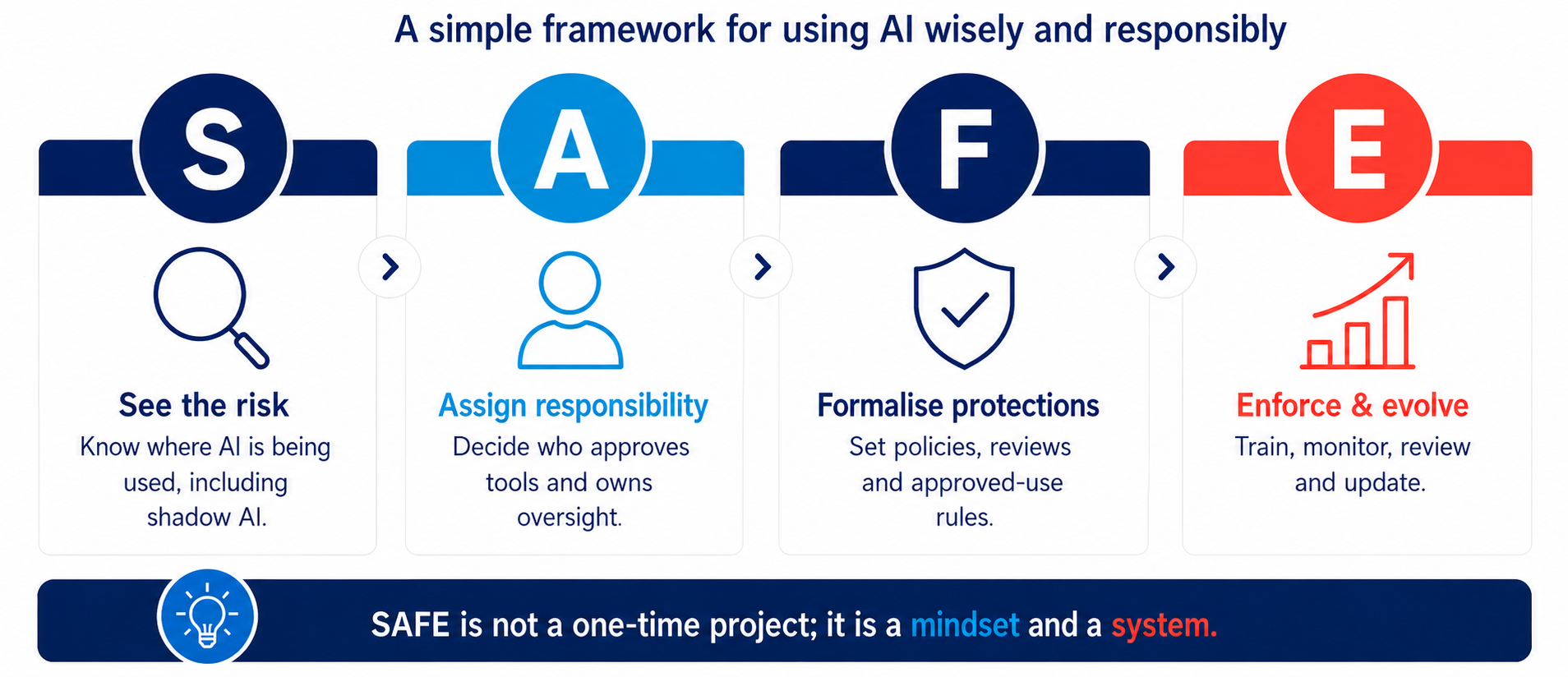
Myla SAFE Framework for AI adoption. (Image: Anne Genge)

Myla SAFE Framework for AI adoption. (Image: Anne Genge)

Trust: When AI creates something we believe

In early 2024, an employee of a multinational company in Hong Kong participated in what appeared to be a video conference with senior executives and colleagues. Deepfake technology was used to impersonate the people on the call, and the employee ultimately authorised a series of fraudulent transfers. Hong Kong authorities later cited the case in warnings about deepfake-enabled deception and the need for independent verification.

For years, cybersecurity training has taught employees to look for suspicious signals: poor grammar, odd wording, an unfamiliar voice or an email that does not sound like the sender. AI is now dissolving those obvious clues. Fraudulent messages can be polished, voices can sound familiar and video can show the face of someone the employee knows. In a dental practice, that could mean an urgent payment request apparently from the practice owner, a call supposedly from an IT provider asking for remote access or a message seemingly from a vendor requesting a banking change.

The answer is not to distrust everything. It is to stop treating appearance as sufficient proof for a high-risk action. Payment changes, password resets, release of sensitive information and unusual requests should be independently verified through a trusted contact method already known to the practice.

AI governance therefore cannot start with policy alone. It has to start with visibility: knowing where AI is already present, what it can touch and who is responsible for it. There are many simple, helpful frameworks emerging and being adapted. In Canada, one that is designed for dentistry is the Myla SAFE Framework.

The four elements of the framework can be applied as follows:

  • See the risk: this means identifying where AI is already being used, including shadow AI, and which data, systems and workflows are involved.
  • Assign responsibility: this means deciding who owns AI governance, approves tools and is accountable for oversight.
  • Formalise protections: this means setting rules for approved tools, privacy and security assessments, vendor due diligence, patient consent where required and human review.
  • Enforce and evolve: this means training the team, monitoring actual use, learning from incidents and updating controls as the technology changes.

The aim is not to do more paperwork. It is a repeatable way for a small practice to see what is happening, assign ownership and keep its safeguards moving with AI.

Conclusion

The goal is not to slow useful innovation or frighten dental teams away from technology that can improve care and efficiency. It is to make sure the controls and the human skills around judgement, verification and oversight mature at the same pace as the capability. The Council of European Dentists has emphasised that AI cannot replace the expertise of the dentist, and the European Federation of Periodontology has described AI as a major force in diagnosis, treatment planning and education.

AI will continue to become more capable and more integrated into dental workflows. The safest practices will not necessarily be the ones that use the least AI. They will be the ones that know where it is, why they are using it, what it can access, what authority it has and when a human must step in. The technology may move quickly, but professional responsibility, practical controls and human judgement still have to keep pace.

Editorial note:

This article was published in digital—international magazine of digital dentistry vol. 7, issue 2/2026

Tags:
To post a reply please login or register
advertisement
advertisement