Digital dentistry continues to have a profound impact on the delivery of clinical care for both patients and clinicians by supporting improved efficiency, greater accuracy and more streamlined workflows.1, 2 Scanning and milling are essential components of the CAD/CAM workflow, supporting assessment of the preparation and restoration requirements, as well as the design and fabrication of high-quality indirect restorations.3 Intra-oral scanning has seen improvements in scanner size, wireless connectivity, image quality and accuracy, but the quality of the digital impression still depends on the scanner system, finishing line design and other clinical factors.4, 5 Milling has also advanced in terms of speed, precision and the range of materials available for CAD/CAM restorative workflows.3, 6 Mobile devices are being developed to provide additional imaging and diagnostic information through connected oral healthcare at home, improving communication for clinicians and access for patients.7, 8
Thermography is an imaging technique in which a thermal camera detects infra-red radiation emitted from an object and generates a temperature-based image from it. Although its dental applications have historically been limited, recent technological advances have enabled its integration into digital clinical workflows.9, 10 Thermal imaging offers a non-invasive method for visualisation, assessment and documentation and has potential procedural application in assessing possible heat generation.11
Digital shade assessment has been available for years, but has not been widely adopted. New developments in connected wireless devices, including phones and tablets, can support a more accessible and standardised workflow for shade assessment and communication.12, 13
Fig. 2a: Medium-diameter titanium dentine pins with drills from the Stabilok Dentine Pin System.
Fig. 2b: Small-diameter dentine pins from the Stabilok Dentine Pin System.
Fig. 3a: Stabilok Twist Drill.
Fig. 3b: Alignment of the drill with the prepared dentoform tooth before pinhole preparation.
Through advances in digital dentistry, restorative workflows can be modified for a simplified approach. Blended dentistry, which integrates conventional tooth preparation concepts with digital and modified indirect workflows, may offer a viable alternative to fully digital or traditional techniques in selected situations.14 One area in which such a blended approach may be relevant is the use of dentine pins, which formed a fundamental component of dental education in many schools for many years; however, advances in adhesive dentistry and restorative materials appear to have contributed to a decline in their use.15, 16 There remains a gap in the scientific literature regarding the combined use of dentine pins and current restorative materials in a digital workflow for the fabrication of pin-retained onlays, often called pinlays.17 The pinlay is a patient-specific and procedure-specific partial indirect restoration designed to repair a fractured or carious tooth.17
Fig. 4: Electric motor set to approximately 2,000 rpm for drilling and dentine pin placement.
Fig. 5: Dentine pin mounted in the contra-angle handpiece before placement.
Fig. 6a: Completed pinlay preparation on tooth #36 with the two dentine pins in place, shown in lingual view.
Fig. 6a: Completed pinlay preparation on tooth #36 with the two dentine pins in place, shown in occlusal view.
Fig. 7a: Completed pinlay preparation on tooth #36 after removal from the dentoform arch, shown in lingual view.
Fig. 7b: Completed pinlay preparation on tooth #36 after removal from the dentoform arch, shown in mesial view.
The use of pinlays provides a conservative, durable and efficient approach and may be considered an alternative to crowns, depending on the patient and the clinical situation.17, 18 In the present investigation, zirconia was selected for the pinlay owing to its physical and aesthetic properties. The author has previously explored lithium disilicate pinlays.17–19
This investigation explored the use of dentine pins for pinlay preparation and the production and assessment of a zirconia pinlay through a novel workflow incorporating thermography, scanning, digital shade assessment and milling. The goal of the investigation was to revisit the fundamentals of pin use, to show how pins may retain and reinforce indirect restorations, and to demonstrate how digital dentistry can simplify and support the workflow for pin-retained indirect restorations.
Methods and materials
Pinlay preparation
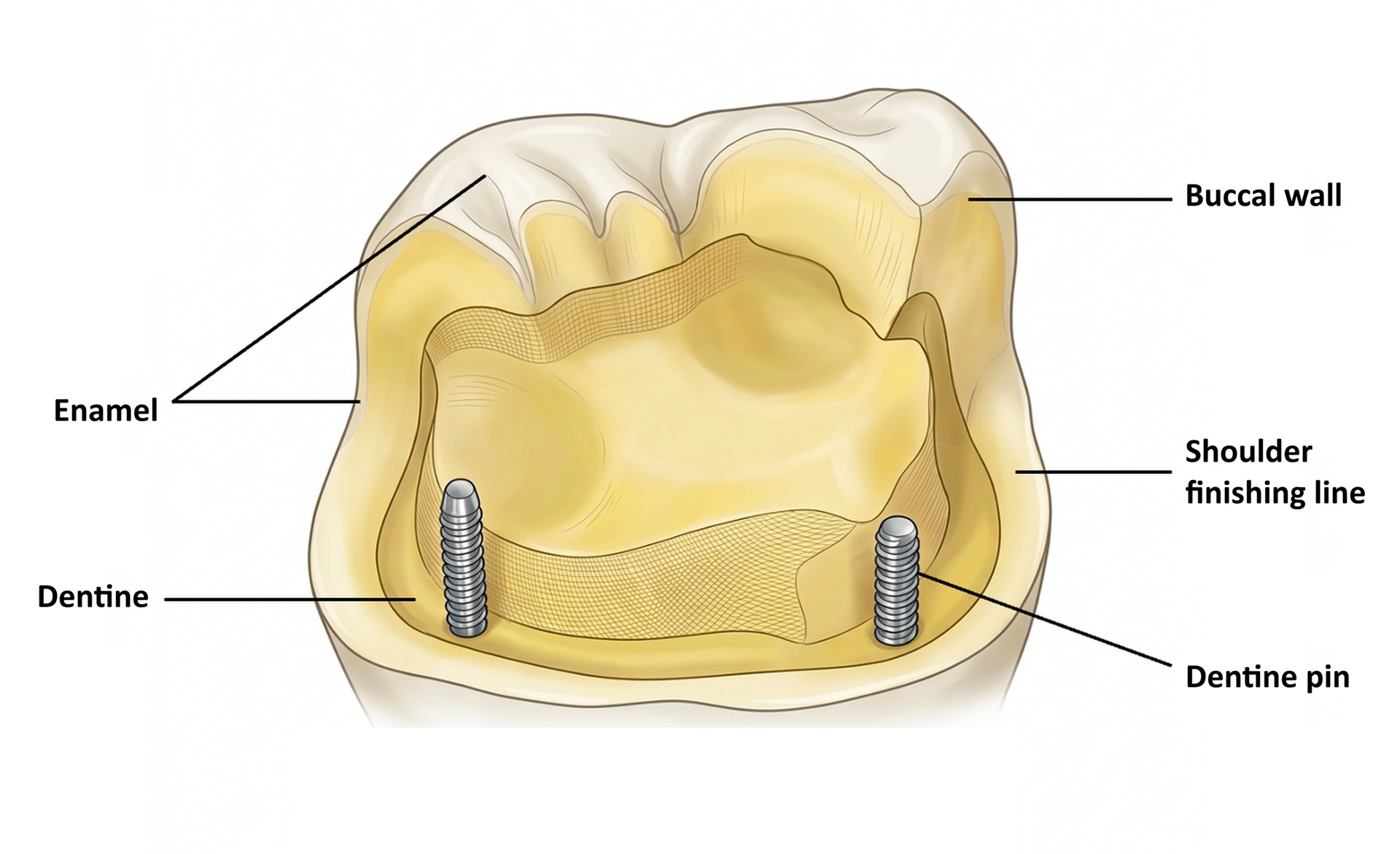
A dentoform tooth #36 underwent preparation for simulated restoration of the mesial, occlusal, distal and lingual surfaces, leaving an unsupported buccal wall (Fig. 1). Treatment was planned for a four-surface zirconia pinlay. Titanium dentine pins (Stabilok Dentine Pin System, Fairfax Dental; Figs. 2a & b) were planned at the mesiolingual and distolingual line angles.
A Stabilok Twist Drill (Fig. 3a) was inserted into a contra-angle electric handpiece. The drill was aligned with the long axis of the tooth and positioned directly over the dentine at the mesiolingual line angle (Fig. 3b). The motor was run at approximately 2,000 rpm (Fig. 4). A single 2 mm deep hole was drilled into the tooth using a rapid in-and-out movement. This was repeated for the distolingual line angle. The drill has a self-limiting shoulder to prevent excessive drilling depth.
Fig. 8: Schematic diagram of the pinlay preparation.
The drill was then removed from the handpiece, and a titanium dentine pin, made of Grade 1 titanium and measuring 0.6 mm in diameter, was placed into the contra-angle handpiece (Fig. 5) and aligned with the mesiolingual drilled hole. The motor was run at approximately 2,000 rpm and the pin gently rotated into the drilled hole. It was threaded into the hole and sheared off at the neck. This was repeated for the distolingual line angle, ensuring that the second pin was placed parallel to the first. The pins may be gently bent to ensure proper orientation and alignment. The pins may also be adjusted in height, if needed, with a high-speed handpiece. The completed pinlay preparation was documented from different views, and a schematic was generated to illustrate the preparation design (Figs. 6a & b; 7a & b; 8).
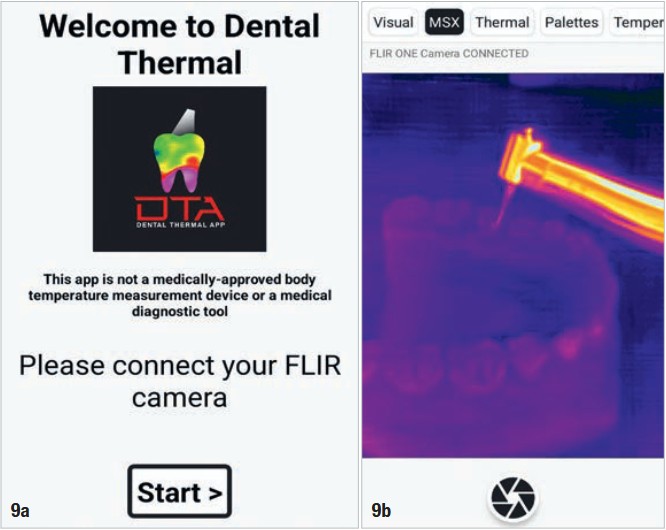
Thermography The Dental Thermal App (Research Driven) was used to assess surface temperature.20 The Android-based software operates on a mobile device and pairs with a FLIR camera (Teledyne FLIR) featuring a thermal resolution of 19,200 pixels, a measurement range of –20 °C to 120 °C and a thermal sensitivity of 0.01 °C. The mobile app was opened, the FLIR camera was attached to the phone and connected, and thermal images were captured during drilling with the Stabilok Twist Drill and placement of each dentine pin (Figs. 9a & b). During image capture, the surface temperatures of the Stabilok Twist Drill and pin were selected and recorded.
Figs. 9a & b: Dental Thermal App welcome screen before connection of the FLIR camera (a) and the connected thermal imaging view during capture mode (b).
Shade assessment The shade of the planned restoration was determined using SmileShade (Research Driven),21 digital shade assessment software, on an iPad and a connected Bluetooth shade sensor (Fig. 10). The sensor was placed directly on the buccal surface of the tooth, and the shade was assessed (Fig. 11). The shade assessment was then displayed on the iPad (Fig. 12a). Project information was entered into the app, and a documentation page was generated (Fig. 12b). The shade assessment indicated a 90% match to Shade A1 on the VITA classical A1–D4 shade guide, and Shade A1 was requested for fabrication of the pinlay.
Scanning of the preparation A Medit i600 intra-oral scanner and Medit Link software were used for digitisation. The dentoform preparation was cleaned and dried. No anti-reflective spray was used before scanning. The preparation was scanned and optimised using Medit Link (Fig. 13) and exported as PLY and STL files (Figs. 14a & b). The STL file was emailed to a commercial laboratory (Alien Milling Technologies) for the design and fabrication of a zirconia pinlay.
Design and creation of the pinlay The STL file was imported into 3Shape software, and a four-surface pinlay was designed by a certified laboratory technologist (Figs. 15a–d). The design was approved. The material selected for the pinlay was Alien Multi-Layer 2.0 (Alien Milling Technologies), a multicoloured zirconia with varying yttria content. The pinlay was fabricated and returned for assessment (Figs. 16a–c).
Fig. 10: Digital SmileShade workflow showing device connection, project creation and shade recording steps.
Fig. 11: Bluetooth-connected sensor positioned on the dentoform tooth to assess and record the shade.
Figs. 12a & b: SmileShade assessment of the dentoform tooth, showing a 90% match to Shade A1 (a), and the generated documentation page for the pinlay project (b).
Fig. 13: Digitised model of the pinlay preparation on tooth #36 with the two dentine pins, captured using the Medit i600 scanner and Medit Link software.
Fig. 14a: Scanned pinlay preparation on tooth #36 exported as a PLY file.
Fig. 14b: Scanned pinlay preparation on tooth #36 exported as an STL file.
Fig. 15a: Digital design of the pinlay in 3Shape software: the occlusal view of the proposed restoration.
Fig. 15b: The scanned preparation with the dentine pins.
Fig. 15c: The restoration design superimposed on the preparation.
Fig. 15d: The internal surface with the corresponding pin spaces.
Fig. 16a: Milled zirconia pinlay: occlusal view.
Fig. 16b: Milled zirconia pinlay: lingual view.
Fig. 16c: Milled zirconia pinlay: internal surface with the two pin spaces.
Results
Zirconia pinlay
The pinlay was seated on the tooth while it was out of the arch, and there were no issues with fit or seating. On visual and tactile assessment, the restoration was deemed technically acceptable in this simulated setting (Figs. 17a–d). The pinlay was further assessed using Fit Checker Advanced (GC; Figs. 18a & b). The assessment confirmed seating of the restoration over the preparation and dentine pins, although it also indicated that a more clearly defined finishing line could have improved margin delineation. The tooth was then placed back into the arch, and the restoration was seated (Fig. 19). Thermography
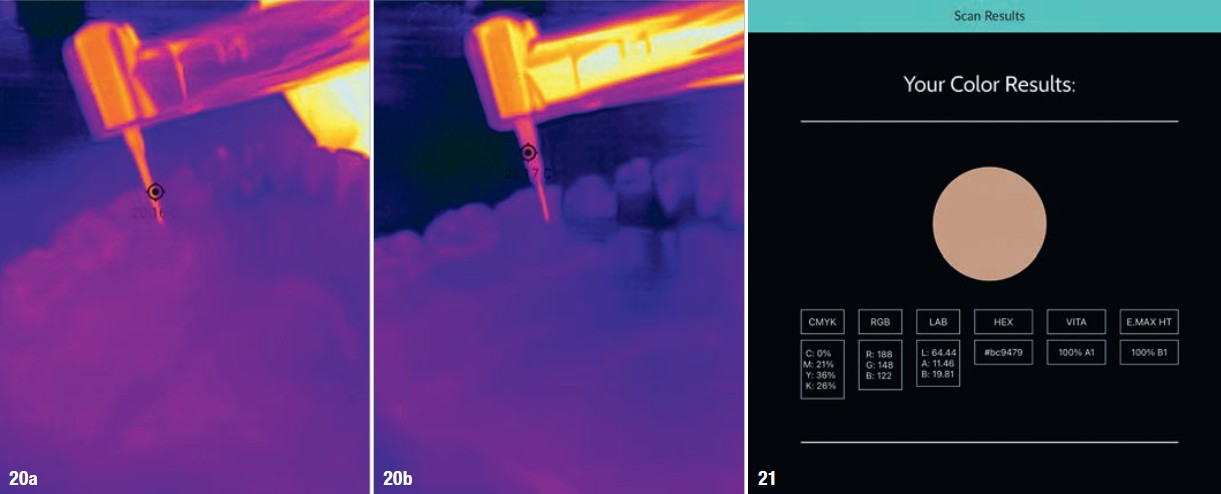
The Dental Thermal App measured and recorded surface temperature using thermal images captured during drilling with the Stabilok Twist Drill and placement of the dentine pins. During image capture, the surface temperatures of the Stabilok Twist Drill and pin were recorded as 20.16 °C and 21.17 °C, respectively (Figs. 20a & b). Shade assessment
The fabricated zirconia pinlay was assessed using the SmileShade technology. It showed a 100% match to Shade A1 on the VITA classical A1–D4 shade guide (Fig. 21).
Figs. 17a–d: Pinlay seated on the prepared dentoform tooth, shown in the occlusal (a), lingual (b) and proximal views (c & d).
Figs. 18a & b: Fit Checker Advanced material used to assess the internal fit of the pinlay on the preparation and the dentine pins, shown in the occlusal (a) and lingual views (b). Fig. 19: Pinlay seated on the preparation after the tooth had been returned to the dentoform arch.
Discussion
Figs. 20a & b: Dental Thermal App recording the surface temperature of the Stabilok Twist Drill at 20.16 °C (a) and the dentine pin at 21.17 °C (b). Fig. 21: SmileShade assessment of the pinlay, showing a 100% match to Shade A1.
This article has demonstrated a digital workflow for a zirconia pinlay in a simulated case. SmileShade provided a simple digital approach for shade assessment and communication, scanning provided the necessary digital information for the design of the pinlay and the milled restoration showed an acceptable fit in this preliminary investigation. Alien Multi-Layer 2.0 appeared to be a suitable material choice based on aesthetics and morphology, as the pins did not affect the restoration shade and the restoration was deemed technically acceptable in this simulated setting. The Fit Checker Advanced assessment also highlighted the importance of a clearly defined finishing line for scanning, CAD and margin delineation.
The purpose of thermal imaging was to visualise and document whether the pin procedure generated increased surface temperature.9, 11 In both procedures, the surface temperatures of the Stabilok Twist Drill and pin did not indicate a noticeable increase, as the recorded values were only approximately 3 °C higher during the procedure than those of the other dentoform teeth. This suggests that, under the conditions of this simulated setting, low rpm and appropriate hand force may not result in a noticeable surface temperature increase. Thermography can be a useful tool for imaging and documentation, especially in procedures that may generate changes in surface temperature, such as cold and vitality testing or dental implant placement.10, 22
Figs. 22a–c: Cast-based pinlay preparation on tooth #26 with two dentine pins, shown in the occlusal (a) and lingual views (b), and the corresponding digitised model of the cast (c).
Figs. 23a–c: Milled zirconia pinlay for tooth #26, shown in the occlusal view (a) and internal view with two pin spaces (b), and fitted on the cast (c).
The author has previously described a pinlay workflow involving conventional impression taking, master cast fabrication and provisionalisation.17 In a separate example, a pinlay preparation was performed on tooth #26 on a dental cast and then scanned and digitised, and a zirconia restoration was designed and fabricated from that scan using the CAD/CAM workflow described in the present article (Figs. 22a–c & 23a–c). The restoration was assessed on the cast and deemed technically acceptable.
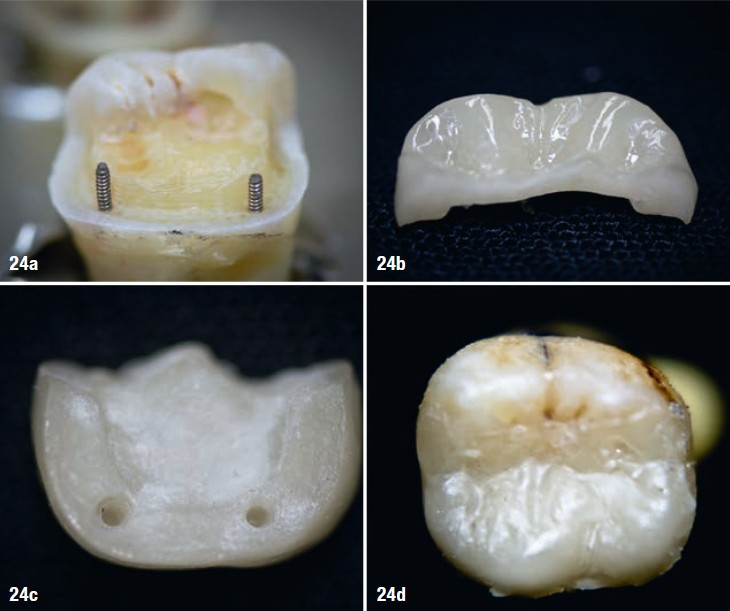
The author has previously evaluated lithium disilicate pinlays on extracted teeth (Figs. 24a–d).18 Fracture resistance testing was performed on the pinlays in comparison with conventional onlays. In that investigation, the highest fracture resistance value recorded was 3,118 N.
Figs. 24a–d: Previous lithium disilicate pinlay investigation on an extracted tooth: the prepared tooth with two dentine pins (a), the external surface of the lithium disilicate pinlay (b), the internal surface of the pinlay with two pin spaces (c) and the occlusal view of the seated restoration (d).
This preliminary investigation using a dentoform tooth outlines a novel approach for zirconia posterior pinlays. However, further research is need using a larger series of specimens, including extracted teeth, and should include together with mechanical testing to evaluate material performance, assessment of 3D-printed pinlays23, 24 and clinical evaluation. Although pinlays have been described as simple, efficient, cost-effective and clinically predictable, these claims relate to the broader pinlay concept; the zirconia CAD/CAM workflow described here requires further investigation before clinical conclusions can be drawn..17, 25, 26
This investigation also highlights the critical importance of laboratory collaboration. Laboratory technicians are specialists in their field, and their involvement early in the project or clinical case can result in a predictable and successful outcome. Professional collaborative teamwork remains essential for dentistry.
Conclusion
Digital dentistry continues to expand and can support clinical workflows by improving accuracy, efficiency and communication between the dental practice and laboratory. The development of novel dental materials has further supported these advances, enabling new restorative approaches and expanding the options available for indirect restorations. This preliminary investigation explored a blended restorative approach, combining a traditional pinlay preparation with digital design and fabrication techniques to produce a zirconia pinlay. Consideration of alternative restorative workflows, including both traditional and modified indirect techniques, remains important for supporting accessible, patient-centred care and adaptable clinical and laboratory workflows.
Implant treatment for full-arch fixed restorations has been around for decades now.1–3 The treatment usually involves four to six implants placed in ...
Full-arch implant-supported fixed protheses have become a highly desired solution for the rehabilitation of patients with terminal dentition or completely ...
TORONTO, Ontario, CANADA: Dental marketing experts Sharky Liu from DentistFind and Adrian Lefler from MySocialPractice will co-host an upcoming educational ...
Within dentistry, what once involved a small number of independent systems now increasingly relies on continuous connectivity between devices, software ...
VANCOUVER, British Columbia, CANADA: This year’s Pacific Dental Conference, one of the largest dental conferences in North America, will include six ...
For more than 150 years, Carl Zeiss has developed optical systems that make it possible to see things invisible to the naked eye. For more than 50 years, ...
I have been a registered denturist for over 20 years. At our laboratory and clinic, we specialise in removable prosthetic solutions: partial dentures, ...
Education
Live webinar Tue. 6 October 2026 1:00 PM EST (Toronto)



 International / International
 Brazil / Brasil
 Latin America / Latinoamérica
 USA / USA
 Austria / Österreich
 Bosnia and Herzegovina / Босна и Херцеговина
 Bulgaria / България
 Croatia / Hrvatska
 Czech Republic & Slovakia / Česká republika & Slovensko
 France / France
 Germany / Deutschland
 Greece / ΕΛΛΑΔΑ
 Hungary / Hungary
 Italy / Italia
 Netherlands / Nederland
 Nordic / Nordic
 Poland / Polska
 Portugal / Portugal
 Romania & Moldova / România & Moldova
 Slovenia / Slovenija
 Serbia & Montenegro / Србија и Црна Гора
 Spain / España
 Switzerland / Schweiz
 Turkey / Türkiye
 UK & Ireland / UK & Ireland
 China / 中国
 India / भारत गणराज्य
 Pakistan / Pākistān
 Vietnam / Việt Nam
 ASEAN / ASEAN
 Israel / מְדִינַת יִשְׂרָאֵל
 Algeria, Morocco & Tunisia / الجزائر والمغرب وتونس
 Middle East / Middle East

 Dr. Stephen Chu DMD, MSD, CDTRegister now1CELive webinar
 Dr. Thomas Martensen M.ScRegister now0.5CELive webinar
 Dr. Andreas KrokidisRegister now1CELive webinar

 Dr. Ramesh Chowdhary PhD, Dr. Robert Gottlander DDSRegister now1CE








![Towards a healthy mouth with [BE YOU.]](https://cdn.dental-tribune.com/dti/0001/514ae21b/cmVzaXplLWNyb3Aodz03NjY7aD00MDYpOnNoYXJwZW4obGV2ZWw9MCk6b3V0cHV0KGZvcm1hdD13ZWJwKQ/up/dt/2018/05/Overview_Design3-1.jpg "Towards a healthy mouth with [BE YOU.]")








To post a reply please login or register